
Transfer from Miritini to Malindi
Approximately 2.5 hours via the B8 coastal road north. Pickup next to Tahmeed Bus stop in Malindi and along the route heading south. Shared shuttle from KSh 1,300 per seat. Private transfer from KSh 7,000. Door-to-door for groups of 6 and above. Last-mile tuk-tuk and boda boda partners for smaller groups - bookable on our website.
Malindi doesn't make the shortlists anymore. Diani gets the luxury resort crowd, Watamu gets the nature lovers, and Malindi sits at the end of the north coast road doing its own thing, largely unbothered.
That's actually a good thing if you know what you're going for.
This is one of the oldest continuously inhabited towns on the East African coast. Vasco da Gama stopped here in 1498 and put up a pillar that's still standing on the coral cliff above the sea. Italy built a satellite launch facility offshore in the 1960s, the scientists stayed, their families came, and now there are third-generation Italian-Kenyan families running restaurants where the nonnas still make pasta by hand. You can hear Italian spoken alongside Swahili in the market. That combination is unusual anywhere in Africa.
Malindi is also the longest transfer from Mombasa SGR Terminus among our regular routes. About 140 kilometres, roughly 2.5 hours north on the coastal road. It's worth understanding the journey and planning accordingly, which is what this guide is for.
1. Getting from Mombasa SGR Terminus to Malindi
The route
From Miritini Terminus we head north on the B8 coastal highway, passing through Mtwapa, across the Kilifi Creek Bridge, through Kilifi town, past Watamu junction, and on into Malindi. It's the longest continuous stretch of our regular north coast route and the scenery along it is genuinely good, particularly the Kilifi Creek crossing.
Our main pickup and drop-off point in Malindi is next to the Tahmeed Bus stop, which is a central and well-known landmark in town. We also stop along the route heading south for passengers whose accommodation is near the highway. If you're further into town or at a property off the main road, our last-mile partner riders connect you door to door.
Transfer type | Shared shuttle or private transfer |
Route | Miritini to Kilifi, Watamu junction, then Malindi |
Transfer time | Approximately 2.5 hours in normal traffic |
Shared shuttle fare | From KSh 1,200 per seat |
Private transfer | From KSh 7,000 (sedan) to KSh 14,000 (minivan, 5-8 pax) |
Main pickup point | Next to Tahmeed Bus stop, Malindi |
Door-to-door | Groups of 6 and above only |
Smaller groups | Last-mile tuk-tuk and boda boda partners - bookable on our website |
Booking | sgrshuttlemombasa.com or WhatsApp |
Factor in the transfer time when planning your schedule
2.5 hours is a meaningful chunk of a travel day. If your Madaraka Express arrives at Mombasa at 2:00 PM, you're looking at arriving in Malindi around 5:00 PM in normal conditions. Plan your first day accordingly - a light dinner and early night rather than an ambitious activities schedule.
Combining Malindi with Watamu
Watamu is about 20 kilometres south of Malindi, roughly 20 minutes by road. Many visitors base in one and day-trip to the other. Our vehicles can handle the Watamu-Malindi leg as a separate booking. If you're spending time in both, mention it when you book your main transfer and we'll plan the connections.
Gede Ruins sits almost exactly between them. Whether you're based in Malindi or Watamu, Gede is an easy stop on the journey between the two towns.
2. What Malindi Is Like
Malindi spreads along a curve of coast where the Sabaki River meets the Indian Ocean. The river carries brown sediment from inland Kenya and spills it into the sea north of town, which means the water close to the river mouth is murky. This is the honest thing most travel guides skip: Malindi's beaches are not as clear or as dramatically beautiful as Watamu's or Diani's. The resort beaches south of town are better than the town beaches, and the water in the marine park area is cleaner than near the Sabaki River outflow.
That said, Malindi offers things the other coast towns don't. It's a proper functioning town with a real market, a working fishing harbour, streets with history layered into them, and a cultural mix that's unlike anything else on this coastline. The Italian community has been here since the 1960s when Italy built the San Marco Space Centre offshore, a satellite launch platform anchored in the shallow waters north of town. The engineers and scientists came, the space program eventually scaled back, but the community didn't leave. Their children grew up here, married locally, and today you have Italian-Kenyan families who've been on this coast for three generations. The restaurants reflect this.
Malindi is also cheaper than Diani for comparable quality. If you're on a longer trip to Kenya and you want a coast stop that doesn't require a luxury budget, Malindi delivers good food, interesting history, and a beach at a lower price point.
3. Things to Do in Malindi
History and culture
Vasco da Gama Pillar: The oldest European monument still standing in sub-Saharan Africa. A bell-shaped coral pillar erected in 1498 by the Portuguese explorer on a cliff above the Indian Ocean. The cross on top is original Lisbon limestone. It's not large but the context is extraordinary. Stand next to something that has been here for over 500 years, on the same coast where dhows still sail the same routes. The adjacent Portuguese Chapel is one of the oldest churches in East Africa. Together they take about an hour and are best visited at late afternoon when the light on the water is good.
Malindi Museum Heritage Complex (House of Columns): A 19th-century building near the seafront housing Swahili artefacts, historical exhibits on the coast's maritime trade routes, and temporary exhibitions. Small but worth an hour if you're interested in how this part of the world worked before European contact.
Malindi town and the old port area: Walk from the museum toward the old jetty and the local fishing beach. This is where you see Malindi as it actually lives rather than how it's packaged for tourists. Fishermen mending nets, dhows being repaired, the ordinary rhythm of a coastal town that has been trading for centuries. Don't bring a camera if you want people to relax around you.
Malindi Tourist Market: A craft and souvenir market that's more curated than the average beach-town stall situation. Kanga fabrics, carved wood, Swahili jewellery. Prices are negotiable.
On and near the water
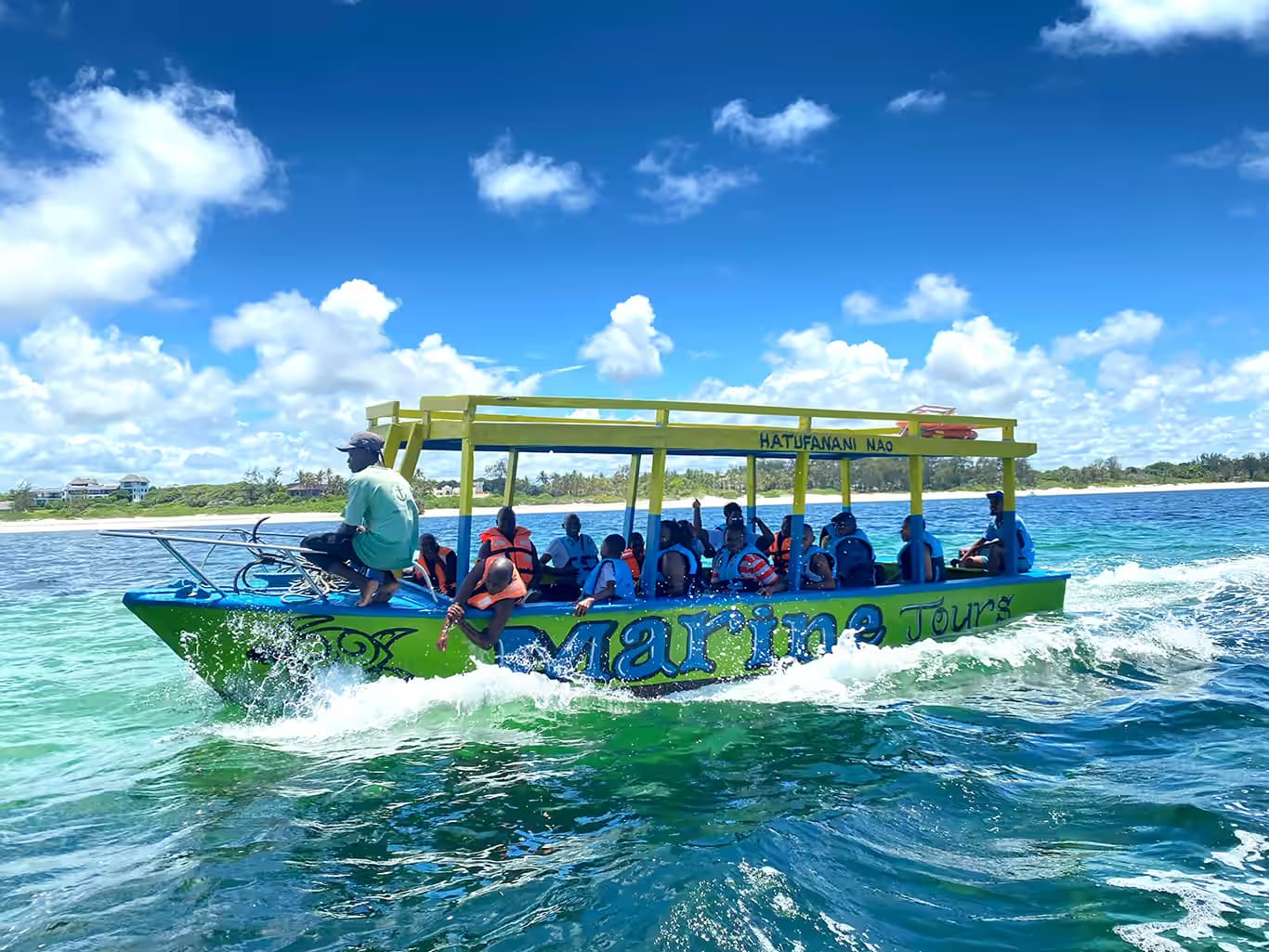
Malindi Marine National Park: Kenya's first gazetted marine park, established in 1968 alongside Watamu Marine National Park. Snorkelling, diving and glass-bottom boat trips. The coral is not as pristine as Watamu's marine park but it's accessible from town and the fish life is good. Glass-bottom boat trips are particularly popular with families.
Deep-sea fishing: This is one of Malindi's genuine standouts. The waters offshore have produced record-breaking marlin, sailfish, barracuda and yellowfin tuna. Hemingway fished here. The captains running charters today have spent decades on these waters and the knowledge is multi-generational. December through April is peak big-game season. Half-day and full-day charters available.
Watamu Marine Park snorkelling (day trip): Twenty kilometres south, Watamu's marine park has better coral and clearer water. A morning trip to Watamu for snorkelling and back to Malindi for lunch is a very manageable day trip. We can arrange the transfer.
Day trips from Malindi
Gede Ruins: About 20 kilometres south toward Watamu. A 13th-century Swahili city largely reclaimed by coastal forest. The same ruins we cover in the Watamu guide. Worth the trip from either town.
Marafa Depression (Hell's Kitchen): About 30 kilometres northwest of Malindi, inland. A sandstone gorge system of red, orange and white rock formations eroded over centuries. Often compared to a miniature Grand Canyon. The colours are most dramatic at sunrise and sunset. Not many visitors come here compared to the coastal sites and it has a genuinely otherworldly atmosphere. A half-day excursion by private vehicle.
Arabuko-Sokoke Forest: Between Watamu and Malindi, one of the largest remaining patches of coastal forest in East Africa. Endemic bird species, elephant shrews, guided walks available.
Sabaki River estuary and bird watching: The Sabaki River mouth north of town is an underrated birding site. Flamingos, waders, and migratory species depending on the season. A very quiet, local experience.
4. Where to Stay in Malindi
Malindi has a decent range but the best properties are not always in the town centre. Several of the more established resorts are on the beach road south of town, closer to the marine park.
Upmarket (from KSh 15,000 per night)
Ocean Beach Resort and Spa: South of town among the sandy dunes, with ocean views, well-appointed suites, a spa, and a seafood-focused restaurant. Old-world charm rather than slick modern design. Popular with European long-stay visitors.
Diamonds Dream of Africa: All-inclusive with Indo-Arabic architecture and Swahili design touches. Popular with Italian tour groups. The food at all-inclusive resorts varies but the setting is good.
Che Shale: Further north past town, a more boutique option on a quieter stretch of coast. Small, personal, and popular with people who don't want to be in the main resort area.
Mid-range (KSh 4,000 to 15,000 per night)
Driftwood Beach Club: A long-established favourite with repeat visitors. Right on the beach, good food, relaxed atmosphere. The kind of place people return to year after year. Book ahead because it fills up.
Eden Roc Hotel: Good central location, pool, reliable service. A solid mid-range option if you want to be walkable from the town centre sights.
Malindi Dream Garden: More boutique, garden setting, quieter than the main beach hotels. A good option if you want to be away from the resort noise.
Budget (under KSh 4,000 per night)
Guesthouses in Malindi town: Several affordable guesthouses in the town centre, typically within a short boda boda ride of both the beach and the historical sites. Quality varies. Read recent reviews and check if the location works for your plans before booking.
Self-catering apartments: Malindi has a reasonable selection of self-catering options at lower prices than the resorts. Good for longer stays where cooking some meals makes economic sense.
5. Where to Eat: The Italian Food Story
The restaurant scene in Malindi is one of its genuine surprises and it comes down to one thing: the Italian community. This isn't imported Italian food for tourists. It's food made by families who've been cooking on this coast for two or three generations, who know where to buy the best local fish, and who take pasta seriously in a way that has nothing to do with a hotel menu.
Baby Marrow: Consistently the most recommended Italian restaurant in Malindi by people who actually know the town. The pasta is made properly. The seafood is fresh. Not expensive by the standards of what you're getting.
La Malindina: Another well-established Italian option with a long track record. Good for evening dinners. The kind of place where the owner comes to your table.
I Love Pizza Malindi: Exactly what it sounds like. Wood-fired, good toppings, proper base. A casual option for lunch or an informal evening.
Seafront restaurants near the old port: Several local restaurants along the seafront road serve grilled fish and crab in a completely unpretentious setting. The fish comes off a boat that was out that morning. These places don't have websites and they don't need them. Ask locally.
Malindi market food stalls: For a true local experience, the market area has stalls selling biryani, pilau, samosas, mandazi, and fresh juice at prices that reflect what Malindi residents actually pay. Eat here at least once.
6. When to Go to Malindi
Malindi follows the same broad seasonal pattern as the rest of the Kenya coast, but a few things are specific to Malindi's position and environment.
Period | What to Expect |
November to March | Best overall period. Calm seas, good visibility, dry weather. Peak for deep-sea fishing. December and January are the busiest and most expensive months. |
December | The Italian expat community swells significantly in December as families return from Europe. The town is at its most lively. Book accommodation well ahead. |
April to June | Long rains. Some hotels reduce hours, restaurants may close for part of the season. Prices drop. The Sabaki River runs high and the sea near the river mouth becomes murky. Good for budget travellers who don't mind occasional rain. |
July and August | The southeast monsoon brings rougher water and some seaweed on the beaches. Still a reasonable time to visit for town activities and historical sightseeing. Good value. |
October to November | Short rains. The whale shark season in nearby Watamu. Good value. A good time to combine Malindi with a Watamu snorkel trip. |
7. Practical Tips for Malindi
The beach near the Sabaki River mouth is murky: This isn't a secret but many first-time visitors are surprised. The river carries sediment that discolours the water near the northern part of town. The beaches south of town around the marine park area and along the hotel strip are significantly cleaner. If the beach was a primary reason for coming to Malindi, stay in the southern hotel zone.
Malindi is a proper town: Unlike Diani or Watamu which are resort environments, Malindi has a real urban centre with traffic, markets, mosques, and ordinary Kenyan town life happening around you. This is part of what makes it interesting but it also means you need to orient yourself properly on arrival.
Boda bodas are the main in-town transport: The town is spread out and walking long distances in the heat is not always practical. Boda boda rates in Malindi are low. Agree the price before you get on.
Cash in hand: ATMs in Malindi work but aren't always reliable. Take cash from Mombasa or the SGR Terminus before you travel. M-Pesa works well for most payments.
Book fishing charters through your hotel or a verified operator: Deep-sea fishing charters vary considerably in quality. Your hotel can recommend a reputable captain. Don't book through a tout on the street.
For Marafa Hell's Kitchen: You need a private vehicle. There's no public transport to Marafa. Arrange a car with driver through your hotel or contact us for a day-trip transfer. Go at sunrise or late afternoon for the best light on the rock formations.
Last-mile connections in Malindi: Our shuttle picks up and drops off next to the Tahmeed Bus stop. If you're at a hotel or accommodation elsewhere in town, our last-mile partner riders can collect you or take you from the Tahmeed stop to your door. Book this alongside your main transfer.
8. Common Questions About Malindi from the SGR
Q: Is Malindi's beach as good as Diani or Watamu?
A: Honestly, no. The beaches in the town centre area are affected by the Sabaki River outflow, which makes the water less clear. The hotel strip south of town and the marine park beaches are better. If pristine beach is your top priority, Diani and Watamu deliver more consistently. Malindi is better chosen for its history, food, fishing and the combination of experiences it offers - not purely for the beach.
Q: Where exactly is the pickup point in Malindi?
A: Our main pickup and drop-off point is next to the Tahmeed Bus stop in Malindi town. This is a central, well-known landmark. If you're at a hotel or property elsewhere in town, our last-mile tuk-tuk or boda boda partners can collect you from your door and bring you to the pickup point, or drop you at your accommodation from the Tahmeed stop. Book this when you book your main transfer.
Q: Is the Italian food in Malindi really good or is it tourist-trap stuff?
A: It's genuinely good, and the distinction matters. The Italian community in Malindi is three generations deep, starting from the engineers who came for the San Marco Space Centre in the 1960s. These aren't tourist restaurants that happened to put Italian names on the menu. Baby Marrow in particular is cited consistently by people who know the town as the real thing. Go at dinner time and order whatever pasta they're making that day.
Q: Can I do Gede Ruins as a day trip from Malindi?
A: Yes, easily. Gede is about 20 kilometres south of Malindi town, about 20 minutes by vehicle. You can combine it with a visit to Watamu Marine Park for snorkelling on the same day. A private vehicle with a driver makes this more comfortable. Arrange through your hotel or contact us for a day-trip transfer.
Q: What is Marafa Hell's Kitchen and is it worth visiting?
A: It's a sandstone gorge system about 30 kilometres northwest of Malindi, inland from the coast. Red, orange and white rock formations eroded into dramatic shapes over centuries. It's sometimes called Kenya's Grand Canyon, which is a stretch, but the landscape is genuinely striking and very few tourists visit it compared to the coastal sites. Worth half a day if you have time and want something completely different. Sunrise or late afternoon visits give the best light.
Q: Is deep-sea fishing from Malindi genuinely good?
A: Yes. This is one of the few things Malindi does better than anywhere else on the Kenya coast. The offshore waters have produced some exceptional catches over the decades, including record marlin. The fishing captains here have generational knowledge of these waters. If you're a serious sport fisherman, Malindi is the right base on this coast.
Book Your Transfer from SGR to Malindi
The longest regular transfer on our north coast route. 2.5 hours, good road, worthwhile destination. Pickup next to Tahmeed Bus in Malindi. Last-mile connections to your door.
Miritini Terminus to Malindi - Approx 2.5 Hours
Pickup next to Tahmeed Bus, Malindi * Last-Mile Partners to Your Door
Shared Shuttle from KSh 1,200 * Private Transfer from KSh 7,000
Book at sgrshuttlemombasa.com or WhatsApp us - we reply within 60 Seconds
Related Guides
Watamu Travel Guide from Mombasa SGR - 20 km south, Gede Ruins halfway between
Kenya Coast Travel Guide: All Destinations from Mombasa SGR Terminus
The Complete Guide to SGR Transfers in Mombasa - all options and prices
Shared Shuttle vs Private Transfer: Which Should You Book?